
Why Do Progressives Like Islam?

1. Pro-Muslim Progressivism
Leftists have been trying to promote the cause of the oppressed for as long as I can remember. When I was in college, they mainly thought of the oppressed groups as women, blacks, and the poor. In the last 20 years, the ranks of oppressed groups have grown. Of particular interest, Muslims are now thought of as an important oppressed group, on whose side good progressives must fight. After warning about racism and patriarchy, the left is also eager to warn against “Islamophobia”. Left-wing protestors now seek to silence speakers who criticize Islam, as happened to Richard Dawkins when he was scheduled to speak in Berkeley. (Dawkins rejects all religion, but only his anti-Islam comments anger people on the left.)
It was also woke activists who got the film Jihad Rehab cancelled. This was a documentary containing interviews with ex-terrorists who were being rehabilitated at a Saudi detention center. It was initially critically acclaimed, before Muslim/woke filmmakers embarked on a campaign to label it “Islamophobic” (with no rational basis) and keep it from being publicly shown.

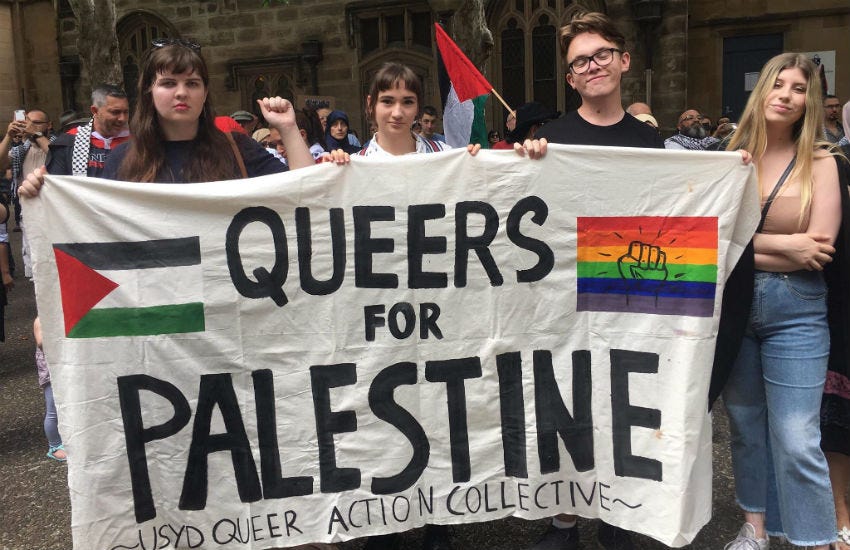
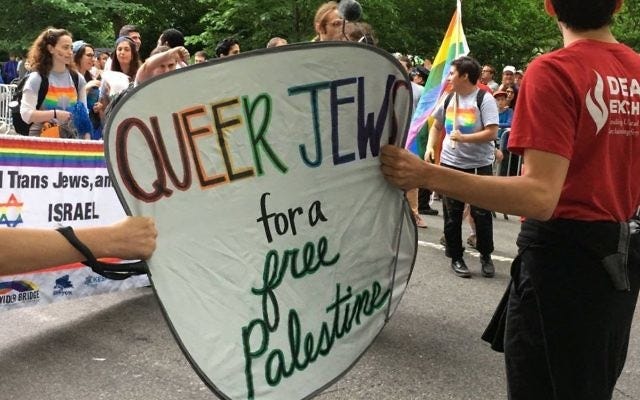
After the Hamas attack on October 7, left-wing students on American university campuses began passionate anti-Israel protests, among which you could find such slogans as “queers for Palestine” displayed unironically. Immediately after the attack, a group of 33 Harvard student organizations released a statement blaming Israel entirely for the attack.
2. The Strangeness of Pro-Islamic Progressivism
Let’s review what is odd about this.
a. Women
Progressives usually speak against what they view as the oppression of women in Western nations, e.g., the fact that women earn 20% less money than men on average (which is due to their choosing different kinds of work). Women in Muslim countries, however, are actually oppressed.
In Saudi Arabia, women have male guardians (typically their fathers or husbands). Until very recently, they needed the permission of their male guardian to get a passport, get married, get official documents, or get a job. Only in 2017 did the Saudi patriarchs decide that women could be allowed to drive.
In Islamic tradition, women are expected to cover their heads. In Iran and Afghanistan, women are legally required to wear the hijab. The most committed Muslims want women to cover their faces as well.
Some forms of Islam consider female genital mutilation mandatory, to prevent women from ever experiencing sexual pleasure.
b. Gays
For context, recall that gay marriage was legalized in the U.S. by the Supreme Court in 2015. Before that, this was a major issue for progressives, who viewed the lack of recognition for gay marriage as a form of intolerable oppression of gays. Even now, many still regard America as oppressive towards gays.
In many Muslim nations, however, the idea of gay marriage is completely beyond the pale; just being gay is illegal. In Saudi Arabia, Iran, Yemen, Mauritania, Nigeria, and Brunei (all majority Muslim countries), homosexuality is a death penalty offense.
Given how much progressives criticize America for its alleged mistreatment of women and gays, one would expect that they would be apoplectic about the horrific oppression of women and gays in many Muslim nations. Yet among those who are most vocal about the oppression of minorities in other contexts, it’s hard to find a critical word spoken about Islam.
3. Progressive Explanations
How could progressives explain this?
a. It’s only a few extremists
Perhaps progressives would say that these forms of oppression are only supported by the more extreme, fundamentalist Muslims and that we should avoid allowing our general view of Islam to be colored by a few extremists.
But we’re not just talking about a small, fringe element in the Islamic world. Again, multiple Muslim nations literally, legally prescribe death to homosexuals. After the October 7 attack, 72% of Palestinians surveyed supported the attack — an attack that massacred teenagers at a music festival, raped and mutilated women, and burned babies.
Progressives don’t seem particularly concerned about portraying Americans, white people, or men as oppressive. Yet the forces of intolerance within each of those groups are a minute fraction of what they are within the Islamic world.
b. US/Israel is worse
Perhaps progressives would say that Israel and the U.S. have caused more harm to Muslims than Muslims have caused to Israel and the U.S.; therefore, it’s more important to protest Israel and the U.S. Perhaps progressives just don’t want to dilute this most important message by adding criticisms of Islam.
Bear in mind, however, that hundreds of millions of people in the world live in Islamic theocracies. So this really doesn’t seem like a kind of oppression that someone whose political worldview revolved around oppression could afford to overlook.
Progressives are also not usually very sympathetic to the “someone else is worse” defense. For instance, during the Cold War, they didn’t see as a good reason suppress their criticisms of the United States that the Soviet Union was worse. They don’t hold off from attacking America’s history with slavery when informed that Arab slavery was worse; they regard that as quite irrelevant.
c. The obligation to fix one’s own society
Perhaps progressives would say that they tend to focus on problems with the West, America, Christianity, etc., because we have an obligation to fix the problems in our own society.
I’m not sure, though, why it wouldn’t also be important to address huge problems in other societies — at least important enough that you would frequently hear progressives talking about the oppression of women and gays in the Islamic world.
Progressives living in America also don’t seem to have any reticence about criticizing Israel, so it doesn’t seem as if the relevant distinction is between one’s own and other societies. It seems that the distinction is Muslims versus (Jews & Christians).
4. Hate
I have a suspicion about the answer. It is not a nice explanation, but it seems to me to fit the evidence.
When did Muslims gain favor with the American left? As far as I recall, it started after 9/11/2001. Before that, I can’t remember the left caring about the plight of Muslims or including them in their “diversity” goals. Before that, Islam wasn’t really on the radar screen of American politics.
Right after 9/11, most Americans were horrified and enraged. But not everyone. Some people on the far left gleefully seized the chance to blame America, just as those Harvard students took the chance to blame Israel for the October 7 attack. An Ethnic Studies professor at the University of Colorado posted an essay on “the justice of roosting chickens”, seemingly explaining the attack as the natural and just consequence of American evil. He compared America to the Nazis and justified killing people in the World Trade Center thus:
“As for those in the World Trade Center... Well, really, let's get a grip here, shall we? True enough, they were civilians of a sort. But innocent? Gimme a break. They formed a technocratic corps at the very heart of America’s global financial empire … If there was a better, more effective, or in fact any other way of visiting some penalty befitting their participation upon the little Eichmanns inhabiting the sterile sanctuary of the twin towers, I’d really be interested in hearing about it.”
Needless to say, the idea that Islamic terrorists are crusaders for socialism and progressive causes as Western leftists understand them is a narcissistic delusion. Al Qaeda, Hamas, and other Islamic extremist groups don’t give two craps about American leftist causes. They are crusaders for Islam. Osama bin Laden attacked America because he wanted to end U.S. support for the Saudi government, so that he could depose them and establish a different, more extreme fundamentalist theocracy in Saudi Arabia. Many people fail to understand this because they can’t imagine a society having completely different issues and different belief systems from ours.
Returning to the point: What do far leftists like about Islam? They like that Islamic extremists hate America. That’s what really matters to them. It’s more important to hate America than to recognize democracy, or free speech, or to treat women or gays like human beings.
The far left’s hatred of America is not explained by America’s mistreatment of this or that group, else they would hate the countries that treat those groups far worse. Rather, hatred of America is a fundamental ideological axiom. Their complaints about America’s alleged oppression of minorities are not driven by concern for those minorities; they are just a tool for attacking America. That is why woke activism doesn’t focus on practical steps to improve the lives of minorities (e.g., programs to reduce out-of-wedlock births, increase graduation rates, or reduce gang violence); it focuses almost entirely on convincing everyone that America is evil.
Granted, most people on the left side of the political spectrum are moderate leftists who don’t really hate America (just as most rightists are moderate rightists, not white supremacists). But people on the left stick together: they’re afraid to criticize anyone on the left side of the spectrum, however extreme. They’re afraid even to undermine the messaging that anyone on their side has undertaken. Hence, even moderate leftists won’t criticize Islam, since that would show disloyalty to their side, since the extremists have decided that the Islamic world is a leftist ally.
Why do the extreme leftists hate America? I still don’t know. This is very strange because most people throughout history, regardless of the society they lived in, had a very strong bias in favor of their own society. What trauma have left-wing extremists suffered that left them with such a deep-seated resentment toward their own society?
It seems to me that most pro Palestine folks aren’t pro Palestine *because it’s an Islamic state* or some such, it’s because they principally reject the aggression of Israel towards the Palestinian people. I mean, just speaking from personal experience, but when religion is brought up in relation to Israel Palestine by my more leftist friends, it tends to be in a historical context (an analysis of who aggressed first and why and so forth) with the purpose of determining that Israel was the aggressor and thus, at fault for the death of the Palestinian people. Now, none of that is to say those are the correct interpretations of the facts, just that the motivation behind the Israel-Palestine protest seems more humanitarian to me, then some attack against Islamophobia.
None of the above undermines the fact that the phenomena you’re talking about does occur (leftists defending Islam) I just think Israel-Palestine is a strange choice because that doesn’t seem to be the primary motivator (at least to me).
I am a progressive, at least broadly speaking--maybe "liberal" would be better, in that I like market economies and freedom of speech and all that, but in terms of pure tribal sympathies, I am clearly a partisan of the Left. This extends to being sympathetic to Palestine and to complaints of Islamophobia.
Now, I don't particularly like or care for Islam as a religion. I think, like most religions, some of its doctrines and practices are good (it is good, for example, at all Muslims are expected to give to charity), some are morally neutral, and some--like the ones you mention--are just awful. But I care about Islamophobia insofar as it actually does exist, and extends beyond just an antipathy for some of Islam's doctrines. Consider how, under French law, there are rules against wearing face-covering headgear in public, with just enough exceptions to allow for everything an atheist, Christian, Jewish, etc. Frenchman might wear, but to forbid Muslim headwear like burqas.
When this was taken up to the European Court of Human Rights by a Muslim woman, the French government's official defense was--it's been some years since I read the decision, and it's 90 pages I don't want to trawl through right now, so this paraphrase will be rough--"In a Republic you need to be able to look people in the eye, and this kind of headgear prevents that." I think when you have a state which has to torture a loose metaphor about equality into literality just to justify why their ban of headgear which effectively is designed to affect only a specific religion isn't really on religious grounds, you are dealing with a case of discrimination against a specific religion, and a violation of practitioners of that faith's freedom of conscience.
Now, of course, there's a fair debate to be had within the left about whether it's something we should disapprove of, wearing the burqa--as it's pretty clearly a symbol of male ownership and oppression of women. But if you're actually committed to liberalism in any way, it's hard to argue you need to *ban* women from wearing it because it comes out of some vaguely oppressive social norm. That itself constitutes a form of marginalization for these women, insofar as their conscience (in error, sure, but error is the price of liberalism) does not allow them to participate in civil society without it, and the law does not allow them to participate in civil society with it.
I bring this up as an example of what I object to when I object to "Islamophobia:" policy effectively designed to marginalize and limit the freedoms of Muslims on the basis of their religion, and attitudes supportive of such policy.
Importantly, I'm not opposed to, e.g., being able to draw pictures of Muhammad and make fun of him without fear of reprisal. I think doing so is classless and rude, and "Islamophobic" in the extended sense--at the very least, I wouldn't do it and I'd recommend other people not do it--but I don't think it's something social policy should aim at eliminating, and people should be protected in their right to do so. And I definitely don't object, even from a "classless and rude" perspective, to a New Atheist going on about the issues and evils of Muslim doctrine (I'd probably agree with many of their criticisms, after all).
I agree, for what it's worth, that there seems to be a faction of the Left that has turned Israel-Palestine especially into a completely polarized debate, where Palestine can do no wrong, and October 7th was a just act of liberation--and we also agree this faction is disgusting. I think the correct psychological analysis of this faction isn't "they hate America, Muslims hate America, Palestine is Muslim, therefore they love Palestine." I think this (sorry) reflects a basic incuriosity about what is driving pro-Palestinian sentiment, since you can see what their complaints *are*: that they believe that Israel is an illegitimately occupying colonial force limiting the freedom and rights of, and ethnically cleansing, Arabs in Palestine, and its stated war goals are largely just a pretext.
And there's two natural follow-ups that I often hear. First, people ask "Why are American leftists focusing specifically on Israel, and not other countries which are much more unambiguously committing genocide?"--well, because the US is a major ally of and funder of Israel, and many companies based in the US invest in the Israeli military and provide material aid to them. Americans have the potential to pressure the US government and US military, and thereby pressure Israel, in a way they don't have the power to pressure Myanmar to stop genociding the Rohingya (also Muslim!) or China the Uighurs (also Muslim! The "it's because they're Muslim" theory fails to predict the different treatment).
The second question is---"why did they support 10/7?" And the first answer to that is that, of course, they shouldn't have, and that was very awful of the American Left. The second answer to that is that not even all pro-Palestinian groups and individuals did, and I think if surveyed most wouldn't. Students for Justice in Palestine is loud, but doesn't claim a monopoly over pro-Palestinian activism. I remember discussing it with progressive friends when it happened, and the general reaction was extremely negative. The third answer is that polarization can take you crazy places, and evil places. If your "opponents" complain about an evil thing "your side" did, and you think in terms of "your side"--a dangerous thing to do, but frequent in politics--it's easy to start reaching for justifications. And so, when pro-Israeli people talk about the evils of 10/7, pro-Palestinians start reaching for justifications. It's a very, very toxic social dynamic, and one that you need to remember actually exists before you start psychoanalyzing people's true motivations. Sometimes it really is as simple as "they dig in their heels when someone brings up a good point against them." (As for those who celebrated 10/7 as it was happening, their process of polarization started well before Hamas actually attacked, but I think worked by a similar process that gradually casts Israel as a singularly monolithic Enemy and Palestinians as monolithic Friends, in a Schmittian sense. At this point, they might be beyond redemption, I don't know.)