
Predation Under Democracy

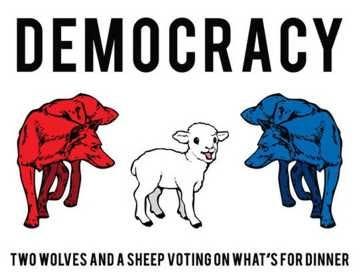
Here, I summarize the failings of democracy.*
1. Conditions for Predation
It turns out that not all humans are uniformly altruistic. Sometimes they rob each other, injure each other, or play annoying rap music on the subway, for personal gain. I call this “social predation”. The harm caused by predatory behavior is usually far greater than the benefit to the predator, so even utilitarians don’t like it. So it would be good to understand under what conditions it happens.
The pro-psychopathy philosopher Thomas Hobbes had a theory about this. It was that predatory behavior happens when people are of roughly equal strength and anyone is a threat to anyone else. When one agent has almost all the power, on the other hand, everything will go great. (Surely this is an unfair caricature? Nope. It’s just funnier and more concise than a normal academic summary, not less accurate. Go read Leviathan.)
The truth is about the opposite. When people are of roughly equal power, it makes sense from the standpoint of self-interest for each to try to cooperate with others and not start conflicts. If, on the other hand, one party has vastly more power than another, it makes sense from the standpoint of self-interest for the more powerful party to exploit and abuse the weaker party for personal gain.
More broadly, we expect people to predate when there are benefits to be gained and they don’t expect anyone to effectively punish them. This could be either because other people won’t know who did the predatory act (or even that it occurred at all), or because other people will be unable to retaliate.
So … government creates the perfect conditions for predation. In most cases, people don’t know what the government is doing and hence are unaware of its specific predatory acts. More importantly, most people have no way of punishing the government anyway. Given this, and given that governments are made up of humans, it would be a shock if governments weren’t predatory. Human history bears out this expectation.
Aside: The economist Mancur Olson theorized that government began when groups of roving bandits decide to become stationary bandits—i.e., instead of leaving after robbing a group of people, they decided to stay there and keep robbing the same group of people. This is a lot more realistic than the “social contract” theory.
2. The Theory of Democracy
In American high school civics classes, they used to teach that America found a good solution to this problem. (I don’t know what they teach today—I assume it’s that America was founded by Satan and Adolf Hitler for the purpose of raping golden retriever puppies, or something like that.) It was a multi-part solution:
The first part of the solution was democracy. Any leader who is abusing the people or generally doing a bad job will get voted out of office. Since people will vote based on their self-interest, the government will have to be at least generally serving most people.
Second, we have a written Constitution, which strictly delimits the powers of the government, thus making it even harder for the government to become abusive or tyrannical. In fine, they won’t be able to put us in concentration camps because no one told them they could. (Ask Fred Korematsu how that worked out.)
Third, we have a system of separation of powers with “checks and balances.” Each branch of government—the executive, legislative, judicial, and bureaucratic (the founders forgot to mention that last one)—has its own important powers, which they can use to restrain the other branches from abusing their powers, which they’ll do because they’re nice people.
Fourth, we have freedom of speech and freedom of the press, which will keep the people informed about what the government and Taylor Swift are up to.
Fifth, in case things really get out of hand, we have the Second Amendment. (Just kidding; that’s a right wing point, so no one was taught that in school.)
Superficially, all this sounds cool. In reality, things don’t quite work like that.
3. Problems with Democracy
a. The tyranny of the majority
What if a majority of voters wants to exploit and abuse a minority? On its face, democracy can’t prevent that. See, e.g., the Jim Crow era in the U.S. Perhaps the only solution is to hope that the culture changes so the majority doesn’t want that anymore.
b. The fate of nonvoters
Democracy also seems to have no way to avoid exploitation and abuse of non-voters who are affected by government policy. Children, future generations, non-citizen residents, convicted felons, and foreigners can all be affected by government policy, yet they have no vote. Iranians, for example, have a stake in whether the U.S. bombs them, yet they have no say in that.
c. Voter ignorance & irrationality
Voters know perfectly well that their vote has almost no chance of making a difference to the outcome of any large election. It therefore makes no prudential sense for them to expend significant time or effort on choosing wisely.
As a result, most voters know almost nothing about politics (this is “rational ignorance”). E.g., they don’t know who their Congressman is, or what the three branches of government are, or what form of government they live under. They certainly don’t know their legislators’ voting records. They have minimal knowledge of most social problems or government policies, and have no idea if a given politician contributed to or detracted from a problem. If the economy goes into recession, hardly any voters will know why, or whom to blame.
Forming correct political beliefs also requires effort, to think critically and avoid our biases. For the same reason, most voters make virtually no effort to do these things. (This is “rational irrationality”.)
d. The failure of political activism
Sometimes, political activism brings progress (e.g., the Civil Rights Movement of the 1960’s). But there are serious limitations to this. It only works for high-profile issues with fairly obvious answers. It doesn’t work for addressing routine inefficiency or miscellaneous corruption. Nor does it work for issues that require detailed knowledge or careful reasoning (see (c) above).
e. The failure of the news media
Theoretically, the news media could keep us informed about the worst failures of the government.
Except that it’s not in their interests to do that. News media is a business, and their business model is based on capturing attention so they can sell it to advertisers. Most of the government’s failures, and the steps needed to fix them, are boring. The way to capture attention is not to provide the most informative or socially beneficial reports about current social issues. The way to capture attention is to provide sensationalism, rage bait, and reports that confirm your audience’s ideological assumptions. That is what the business model calls for, so that is what we see. Even if a few sources like Fake Nous provide genuinely informative and socially beneficial information, those sources will just get out-competed in the marketplace by Candace Owens and Cathy Newman.
f. The miracle of aggregation
If ignorant voters voted randomly, things could still work out. Say 98% of voters choose a candidate randomly. The remaining 2% all vote for the objectively better candidate. Then, in a 2-candidate race, the better candidate wins, 51%-49%.
Unfortunately, ignorant and irrational voters aren’t coin-flippers. They instead vote based on superficial factors, such as who is better looking, or taller, or what “identity groups” each candidate purports to represent. The combined effect of these irrelevant factors is unlikely to be an even or nearly-even split between the major candidates. Any of these irrelevant factors can swamp the effect of knowledge and sound reasoning.
g. The rewards of government failure
In the free market, when you fail at your job, you usually get replaced. If your business was just broken into last night, you’ll probably fire your security guard and hire a different company.
Things work otherwise with government. When they fail, we can’t fire them and hire one of their competitors. So instead, we just give them more money and power. E.g., if crime goes up, instead of firing the police, we give more funding to the police. If there’s a terrorist attack, we give the government more money and power to fight terrorism. If poverty gets worse, we increase funding for anti-poverty agencies. Etc.
What we overlook is that this means the government has no incentive to succeed. Their incentive is to fail. Maybe that’s why they are so good at failing.
Qualification: Sometimes, politicians get voted out because social problems worsened during their terms. But other times, their popularity increases (e.g., George W. Bush after 9/11). And broad government programs and agencies generally get more money and power when the problems they’re supposed to address worsen.
h. The failure of the Constitution
A written Constitution is a good idea. There is one problem, though: what if the government violates it? Who is going to punish them?
“Surely,” you say, “this would hardly ever happen! Government leaders are kindhearted souls who yearn only to serve their fellow man.”
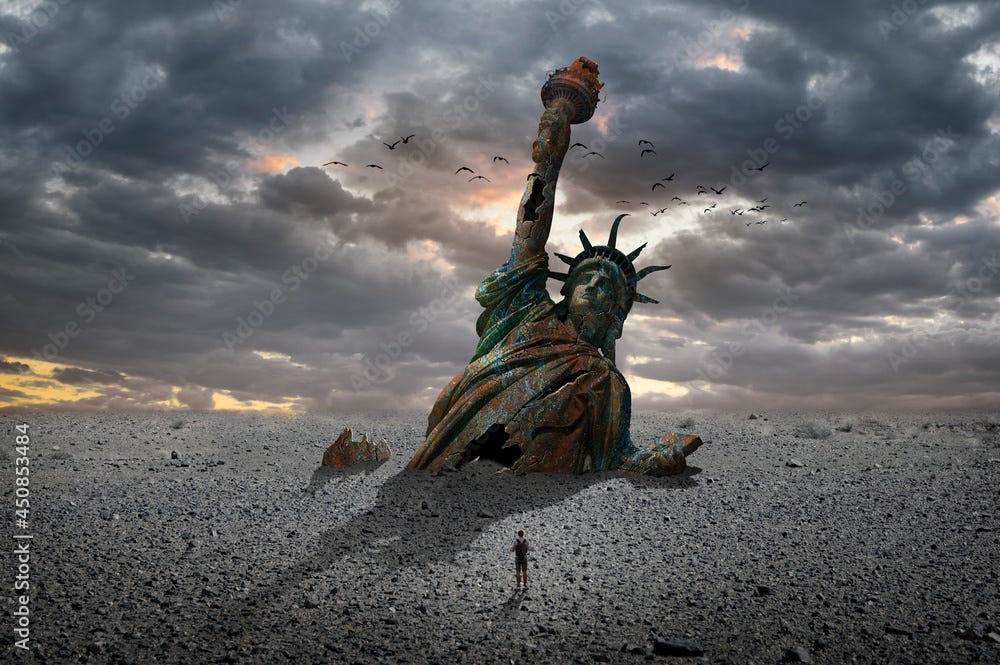
I’m afraid this is not always true; every once in a while, there is a politician who values power more than the freedom of the people.
Most Americans appear blissfully ignorant (see (c) above) that nearly everything the federal government does is unconstitutional. See the Tenth Amendment to the U.S. Constitution:
Amendment X: The powers not delegated to the United States by the Constitution, nor prohibited by it to the States, are reserved to the States respectively, or to the people.
Any federal government activity that is not expressly authorized by the Constitution is unconstitutional. (This is uncontroversial.) That includes almost everything the federal government does. (To see what few things the government is authorized to do, see Article 1, section 8.) The government long since stopped caring about this. Almost no one cares or even thinks about it anymore, other than libertarians.
i. The failure of checks and balances
What about the virtually impregnable system of checks and balances devised by the Founders? Unfortunately, it has one flaw: it assumes each branch of government will use its powers to prevent other branches from abusing their powers, rather than using its powers, say, to stop the other branches from restraining it, or to help the other branches abuse their powers.
For example, the Executive and Legislative branches each have a “check” on the Judicial branch, because Supreme Court justices are appointed by the President and approved by the Senate. So the President and Senate could use this power to
(a) ensure that only judges with a firm commitment to upholding the Constitution will ever be on the Court, or …
(b) ensure that only judges who will rubber stamp expansion of federal power will ever be on the Court.
Which one do you think would happen? I guess the Founders thought (a). It turned out to be (b). That is why the Supreme Court doesn’t do anything about the >90% of government programs that are unconstitutional.
4. Conclusion
The high-school civics theory of democracy is foolishly optimistic. Democracy works well at avoiding obvious, widespread, near-term disasters. It is not so good for problems that are subtle, or only affect a minority (especially an unpopular minority), or that will occur after the current politicians are no longer in office. There are a lot of those problems.
Before you start clamoring for dictatorship, wait!—dictatorships don’t even stop the obvious, widespread, immediate disasters. E.g., a dictator might go ahead and cause a famine that kills millions of people. Dictatorship and democracy are basically the two forms of government that people have come up with (“fascism”, “communism”, and “monarchy” all being variants of dictatorship). This is why Churchill called democracy the worst form of government except for all the others that have been tried.
It’s the best form of government, but it’s kind of crappy. Maybe one day, we’ll be able to evolve beyond government.
[ *Based on: The Problem of Political Authority (2013), ch. 9. ]
Maybe I’m too ideologically motivated, but I genuinely believe that governments pose the greatest risk to human extinction. That’s why I think building institutions that can compete are important. That effort goes hand in hand with educating people to accept alternative institutions and getting rid of the illusion of political authority. https://morologia.substack.com/p/regulatory-entrepreneurship-is-morally?r=6xuckk&utm_medium=ios