

In an earlier post, we saw that infinity is paradoxical. Here, I explain what infinity is.* Hint: It isn’t a number.
1. What Are Numbers?
1.1. Three Kinds of Quantities
There are three kinds of numbers or quantities:
There are cardinal numbers, or counting numbers (1, 2, …).
There are magnitudes, which are represented using real numbers. These divide into two species (which will be interesting later):
Extensive magnitudes, which are additive over a thing’s parts. E.g., length is extensive: the length of the left half of an object + the length of the right half = the length of the whole.
Intensive (or non-extensive) magnitudes, which are non-additive. E.g., the temperature of the left half of an object + the temperature of the right half does not = the temperature of the whole.
1.2. Properties & Relations
The counting numbers are properties that are instantiated by multiple things. E.g., Twoness is a property that is instantiated by any two things (or: the property that every pair has in common with every other pair). The sun and my left eye together are two (they together possess the property of twoness).
Real numbers are relationships that a magnitude can stand in to a unit. E.g., I’m 5.79 feet tall. The “5.79” there refers to the relationship of a physical magnitude (my height) to a standard unit (the foot), which is itself another property.
1.3. Determinacy
Some quantitative concepts are to some degree indefinite (they don’t specify an exact amount), e.g., “a few” or “ginormous”. Other quantitative concepts are determinate, i.e., they denote a single, specific amount, like “2” and “5.79”. Number concepts are maximally determinate quantitative concepts.
2. The Argument for Infinite Numbers
2.1. About Numbers
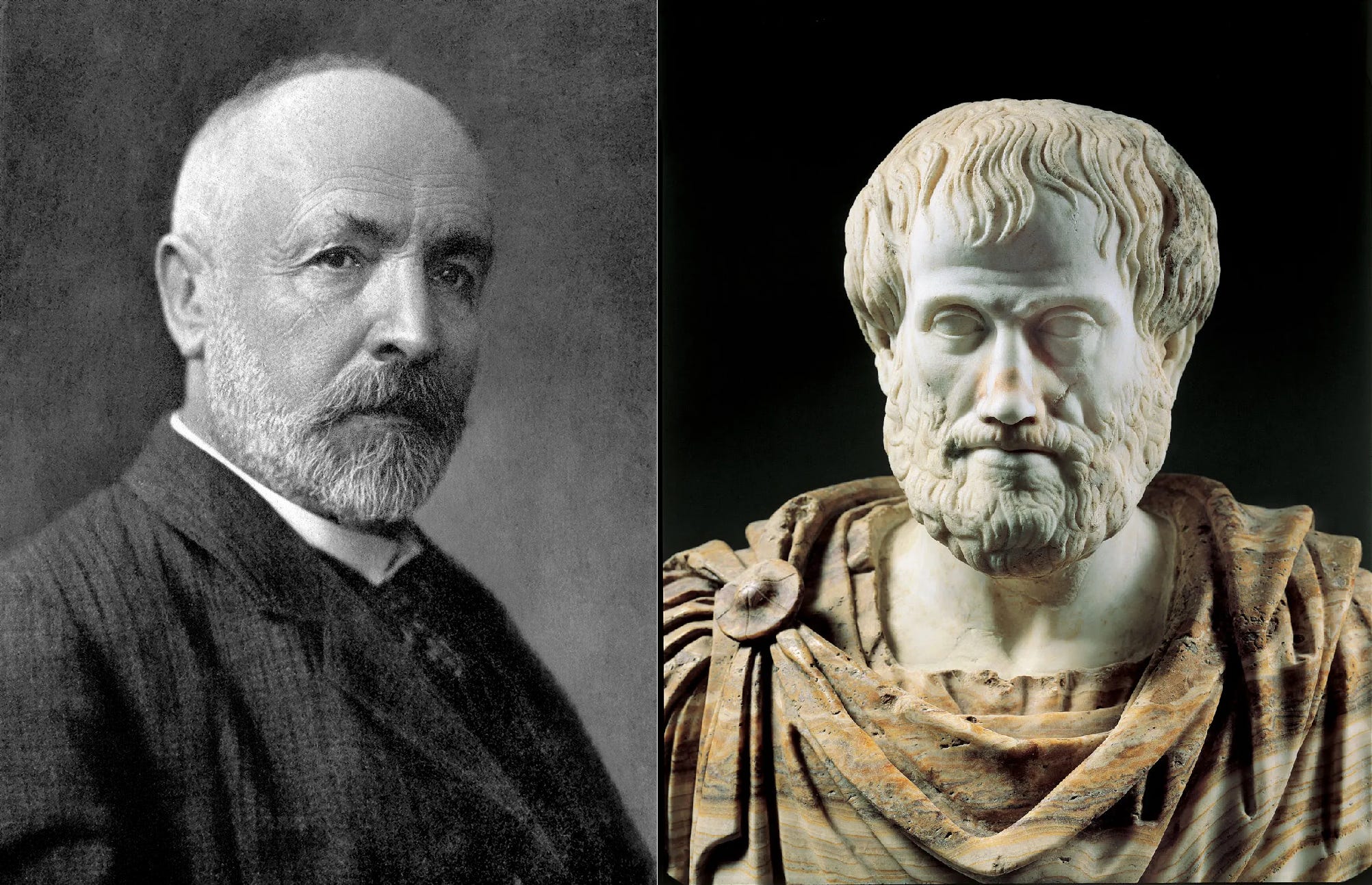
Georg Cantor (founder of set theory), Gottlob Frege (founder of predicate logic), and Bertrand Russell gave their own theories about what numbers are. It’s easiest to explain Russell’s version:
0 is the set of all sets that can be put in one-to-one correspondence with the empty set (that is, 0 is {{}}).
1 is the set of all sets that can be put in one-to-one correspondence with {0}.
2 is the set of all sets that can be put in one-to-one correspondence with {0,1}.
Etc. You can then make similar “reductions” of addition, the greater-than relation, and other arithmetical concepts. Cantor’s and Frege’s accounts are broadly along the same lines.
The point of making these seemingly ridiculous assertions is that then you can define all arithmetical concepts using only concepts of logic and set theory. You can then supposedly derive all of mathematics from logic and set theory, which is supposed to be good, for reasons that were never clear to me.
Anyway, that later turned out to be false. Kurt Gödel proved that you can’t in fact derive arithmetic from logic & set theory. But people still kept going on saying these kinds of things about what numbers are.
I think it’s obvious on its face that when people use “two” or “2”, they are not talking about that set, or anything like it. They are talking about the thing that my hands have in common with the moon and the sun, etc.
2.2. About Infinite Numbers
People who have read a tiny bit about infinity (and consequently think they know all about it and have very dogmatic opinions about it) often think that Cantor has some kind of mathematical proof that there are infinite numbers. But of course he has no such thing.
The actual argument for there being infinite cardinal numbers starts from the assumption that cardinal numbers are the sort of thing described in 2.1 above. One next notices that one can formulate a definition would be parallel to the definitions given for 0, 1, 2, and so on, but that wouldn’t correspond to any of the natural numbers. To wit:
ℵ0 is the set of all sets that can be put in one-to-one correspondence with {0, 1, 2, …}.
Because that’s parallel to the definitions for 0, 1, 2, etc., that appears to count as a definition of another number. But this number would have to be infinite. So there’s an infinite number.
Where I get off the boat: I see no reason to believe that a number is a set, or any kind of set theoretic construction, so I see no reason to think ℵ0 is a number.
2.3. The Case for Different Sizes of Infinite Number
The little bit that people often learn about Cantor’s theory is the argument for there being different infinite numbers, given that we already accept the idea of an infinite number. Basically, you can have different sets of infinite sets that can be put in one-to-one correspondence. E.g., you have the set of all sets that can be put in one-to-one correspondence with the set of real numbers, which is different from the set of all sets that can be put in one-to-one correspondence with ℕ, and then there’s the set of all sets that can be put in one-to-one correspondence with the powerset of ℝ, etc. These are different, so there are multiple different infinite numbers.
Btw, all of these Cantorian “infinite numbers” are meant to be cardinal numbers (not magnitudes), so they’re an extension of the natural numbers (not an extension of the real numbers).
2.4. Hyperreal Numbers
For an extension of the real numbers, we have the hyperreals, which include numbers meant to represent infinite magnitudes, plus infinitesimal numbers (numbers smaller than any positive real number, but larger than zero). You can model hyperreal #s using infinite sequences of real numbers. If the sequence approaches 0, you have an infinitesimal number; if it diverges, you have an infinite number. It’s all very cool. I just think it’s all a fiction.
3. Infinity Isn’t a Number
3.1. The Number Line
Whether you’re talking about cardinal numbers or magnitudes, the structure of the (non-negative) number line is like this:

(a line stretching to the right forever). It is not like this:

(a line stretching to the right forever, followed by another point after the line). Nor is it like this:

(a line stretching to the right forever, followed by another line stretching to the right forever again). There’s nothing “after forever”, and there aren’t any numbers larger than all the natural numbers, or larger than all the real numbers.
3.2. Examples
Consider the conundrum, “What happens when an irresistible force meets an immovable object?” The answer is that there are no such things. There aren’t any infinite quantities, only larger and larger quantities without limit. So there is no infinite force, nor is there anything with infinite inertia.
Or consider: “If an object traveled at infinite speed for 1 second, where would it wind up?” Again, this is impossible. There are larger and larger (logically) possible velocities something could have, without limit, but there’s no possibility of infinite velocity.
3.3. Indefiniteness
Number concepts, again, are fully determinate quantitative concepts. The concept SEVEN is a number concept. The concept A LOT is also a quantitative concept, but it isn’t a number concept because it’s not determinate.
How can you tell when you have an indeterminate quantitative concept? One way is that you can add or subtract a certain amount, and the concept still applies. Example: if you have “a lot” of meerkats, and then you add three more meerkats, the concept A LOT still applies.

By contrast, if you have seven meerkats, and you add three more meerkats, the concept SEVEN doesn’t apply anymore. That’s because seven is a definite quantity, whereas a lot is not.
“Infinity” works more like “a lot”: If you have infinite meerkats, and you add three more, you still have the same (order of) infinity of meerkats. This is a symptom of the fact that infinity isn’t a definite quantity.
What is it then? It might be easier to talk about how the concept of the infinite functions rather than about what infinity is, because “infinity” may not refer to anything, though the word “infinite” has a correct use.
When you say that something is infinite, what you’re saying is essentially that it exceeds every definite quantity. That is very different from assigning it a specific quantity. Thus, to say you have infinite meerkats is to say that for every number n, there is a group of more than n meerkats. Notice that this does not require positing a number that’s larger than all the natural numbers.
3.4. Arithmetical Laws
Another characteristic of number concepts is that you can deploy them with arithmetical operations. E.g., SEVEN and THREE are number concepts, so you can sensibly talk about 7 + 3. But “a lot” and “ginormous” are not number concepts, so you can’t really talk about “a lot + ginormous.”
“Infinity” works more like “ginormous.” If you try applying arithmetical operations to it, you get weird results. Like you say “∞ + 1 = ∞”, and then it seems like you can subtract ∞ from both sides, thereby getting “1=0”.
There is no number that is 1 larger than itself. But the equation “∞ + 1 = ∞” appears to say that ∞ is one unit larger than itself.
Or: If you have some number of objects, and then you add a nonzero number of additional objects, the result is that you have more objects, i.e., a larger number of objects. This is axiomatic. But ∞, if it be treated as a number, violates this principle.
You could try claiming that ∞ is a number that obeys its own special rules different from the other numbers. But if it behaves sufficiently differently from the normal numbers, then it’s simpler to say it isn’t really a number. If you’re going to insist that it’s a number no matter how much it differs from the accepted examples of numbers, then you’re making your thesis unfalsifiable.
My account explains how infinity differs from the genuine numbers, and it explains all of the above facts. I don’t know why one would want to keep claiming that ∞ is a number.
4. The Pre-Cantorian Orthodoxy
The great mathematician Carl Friedrich Gauss wrote:
I must protest most vehemently against your use of the infinite as something consummated, as this is never permitted in mathematics. The infinite is but a façon de parler; an abridged form for the statement that limits exist which certain ratios may approach as closely as we desire, while other magnitudes may be permitted to grow beyond all bounds. [letter to Schumacher in 1831]
This was more or less the orthodox view in mathematics pre-Cantor. This is the reason for the delta-epsilon definitions in calculus (in standard analysis)—they were specifically devised so that we could understand derivatives and integrals without positing infinite or infinitesimal numbers.
This sort of view goes back to Aristotle, who argued that there cannot be an “actual infinity” because (i) everything actual must be fully determinate, and (ii) to be infinite is to lack a determinate amount of something. This all coheres with what I’ve said above.
How did Georg Cantor overthrow this sensible orthodoxy? It started with the sort of theory discussed in 2.1 above, along with the promise to derive all of mathematics from set theory. Wouldn’t that be cool?
The promise was never kept, and we subsequently learned that it could not be kept. But the apparatus of transfinite arithmetic was so cool that people held on to it (“No one shall expel us from the paradise that Cantor has created for us!”, as David Hilbert put it), and no one thought too hard about whether numbers are really the sort of thing Cantor said they were.
Most mathematicians don’t care much about that sort of question (it’s more of a philosophical question), and philosophers easily get confused when someone starts giving mathematical definitions and proofs. So no one really notices that there was never any serious argument for thinking that ℵ0 is a number.
We tend to assume that later views (e.g., Cantor) are more sophisticated than earlier views (e.g., Aristotle). And to some extent, that’s true. But on the fundamental matter here, Aristotle was more right.
[ *Based on: Approaching Infinity, chs. 9-10. ]
Huemer is right that infinity behaves like an indefinitely extensible quantifier rather than a determinate magnitude. That distinction resolves the classic paradoxes: Hilbert’s hotel, Galileo’s paradox, “∞ + 1,” infinite speed, infinite force — all arise only when an indeterminate concept is treated as a completed quantity. Once infinity is understood as “exceeds every determinate amount,” the paradoxes dissolve without needing transfinite arithmetic.
A second angle pushes the point further. If the universe were infinitely extended, it would be a plenum with no vacancy. In a plenum, motion is impossible because displacement requires empty space. But speech requires motion — pressure changes, vibration, articulation. So the very possibility of uttering the proposition “the universe is finite” is incompatible with an infinite universe. Asserting finitude is evidence of finitude. Here, infinity isn’t just an indeterminate quantity; it’s physically incoherent.
I don't know what maximally determinate means, but Cantor's infinities do differ from concepts like "a lot" in that they're objective: two people who agree on the definitions won't disagree about whether the cardinality of some set is aleph null, but they might disagree about whether we have a lot of toilet paper in the house. In this way, the infinities are like what you call numbers.
Sections 2.1 and 2.2 are hard to understand. Was Russell really saying that his sets are "the numbers"? Or was he simply constructing specific objects that have the properties you describe in Section 1.2? The motivation for infinite numbers in Section 2.2 works equally well if we start with the Section 1.2 definitions instead of with Russell's objects: there's a property of a jelly bean and another jelly bean that we call "two", similarly for "three" and so forth, why shouldn't there be a similar property for endless jelly beans?